
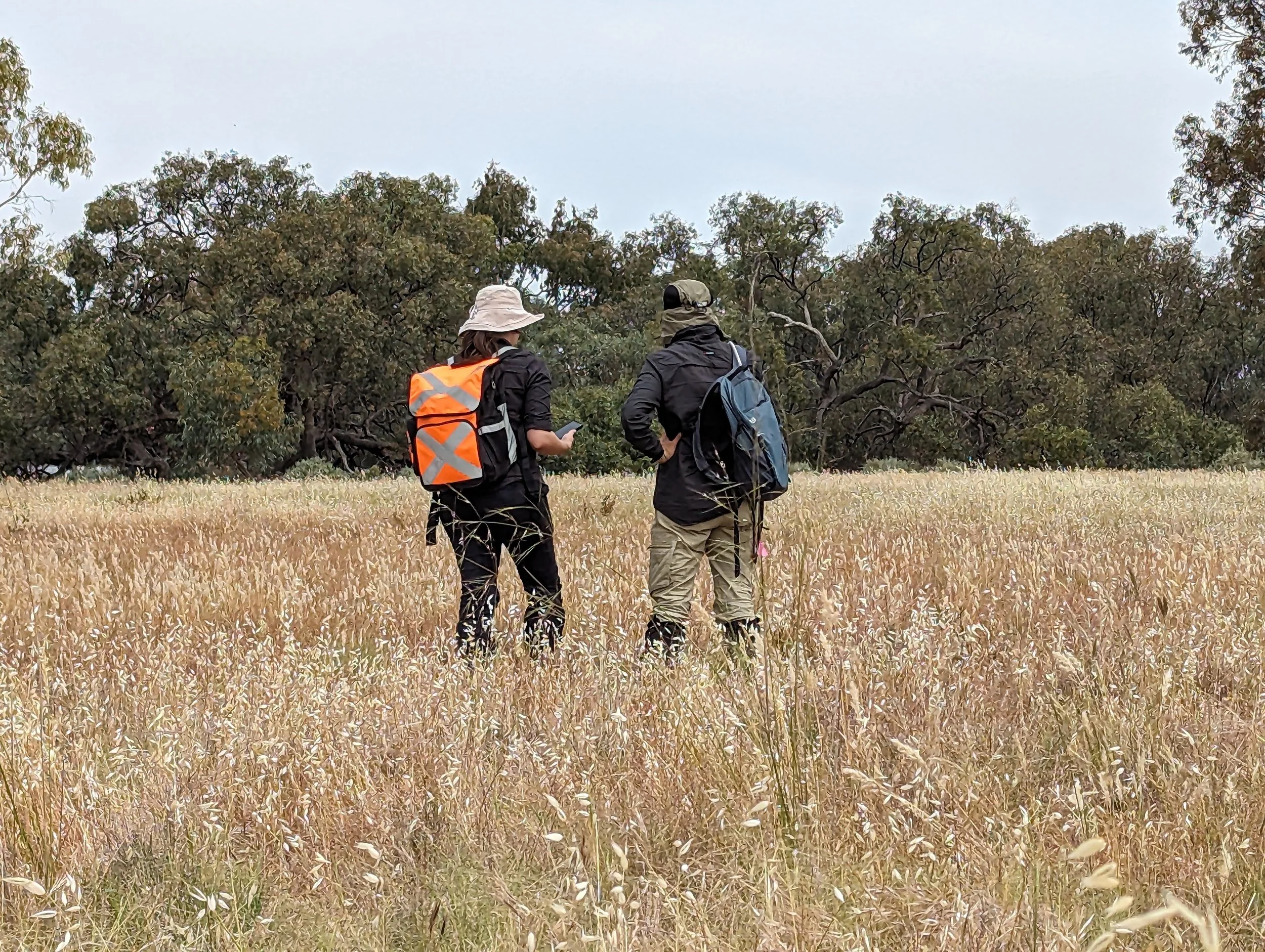
This glossary has been developed as a practical reference for people working in applied ecology, land management and environmental planning in Australia. It is aimed at practitioners who regularly operate at the intersection of field ecology, spatial analysis, landscape function and ecological restoration. This includes consultants, land managers, planners, students and agency staff. Rather than attempting to be comprehensive or academic, the list focuses on terms that are commonly used in real-world ecological work: assessing landscape condition, planning and implementing restoration, interpreting spatial data, and navigating Australian policy and regulatory frameworks. Key themes include landscape ecology and function, soil and vegetation processes, monitoring and restoration practice, basic GIS concepts, and Australian-specific legislation and planning tools. The glossary is intended as a shared language for practice, supporting clearer communication, better decision-making, and more consistent interpretation across projects and disciplines. It is in alphabetical order. You may find it simplest to use your browser’s “Find” function to find the term you need.
Glossary of Terms for Practicing Ecologists
Abiotic – Non-living components of an ecosystem, such as soil, water, climate, rocks and nutrients.
Accepted development vegetation clearing codes (Queensland) – Queensland’s code-based pathway for certain low-risk clearing activities that can be “accepted development” when conditions are met.
Accredited Consultant (South Australia) – A consultant endorsed by the SA Native Vegetation Council to prepare clearance Data Reports and (where relevant) SEB management planning.
Action (EPBC Act) – A project, activity or development that has the potential to impact a Matter of National Environmental Significance and may require assessment under the EPBC Act.
Action management plan – A document setting out how impacts on protected matters will be avoided, minimised, managed or offset as part of an EPBC approval.
Advisory committees – Expert groups established to advise government on environmental matters, often relating to threatened species, communities or ecosystems.
Assessment – A structured evaluation of ecological condition, impacts, risks or outcomes, often supporting planning, restoration or regulatory decisions.
Assessment method – The formal process used to assess environmental impacts under legislation or policy.
Assessment pathway – The level of assessment required for an activity, based on risk and scale (e.g. basic, intermediate or detailed).
Attribute (GIS) – Information stored in a spatial dataset that describes a mapped feature, such as vegetation type or condition score.
Avoid–Minimise–Offset (three-step approach) – A hierarchical framework requiring impacts to be avoided where possible, minimised where unavoidable, and offset only as a last resort.
Biodiversity – The variety of life at genetic, species and ecosystem levels.
Biodiversity Assessment Method (BAM) (New South Wales) – The NSW method used to quantify biodiversity impacts and gains (including via ecosystem credits and species credits) under the Biodiversity Offsets Scheme.
Biodiversity Assessment Report (New South Wales) – The report produced by an accredited assessor applying the BAM to document impacts, required credits, and assessment results.
Biodiversity Conservation Act 2016 (New South Wales) – NSW legislation underpinning threatened species and the Biodiversity Offsets Scheme (commonly referenced in vegetation clearing/offset contexts).
Biodiversity credits (New South Wales) – Units (ecosystem credits and species credits) used to measure and offset biodiversity losses under the NSW scheme.
Biodiversity Offsets Scheme (BOS) (New South Wales) – NSW framework requiring assessment and offsetting for certain developments/activities, using BAM and credits.
Biodiversity Stewardship – Australian programs that support voluntary conservation and long-term protection of biodiversity on private land.
Biodiversity stewardship agreement (New South Wales) – A NSW agreement mechanism used to secure and manage land for biodiversity outcomes and generate credits under the NSW scheme.
Biodiversity value of native vegetation – The assessed ecological importance of native vegetation based on condition, landscape context and contribution to biodiversity.
Biodiversity Values Map (New South Wales) – A spatial layer used in NSW to identify land with high biodiversity value for regulatory/assessment triggers.
Biogeochemical cycling – The movement and transformation of elements such as carbon, nitrogen and phosphorus through soil, water, air and living organisms.
Biomass – The total mass of living plant or animal material in a given area.
Biophysical mapping – The spatial mapping of physical and biological landscape features such as vegetation, soils, landform and hydrology.
Biotic – The living components of an ecosystem, including plants, animals, fungi and microorganisms.
Boundary – The interface between different landscape elements or land-use types.
Buffer (GIS) – A mapped zone of a specified distance around a feature, commonly used for impact assessment or protection areas.
Category 1 – Exempt land (New South Wales) – NSW rural land category where native vegetation clearing may be allowed without approval from Local Land Services (subject to other controls).
Category 2 – Regulated land (New South Wales) – NSW rural land category where native vegetation clearing is regulated and may require approval/conditions under the Land Management framework.
Category 2 – Sensitive regulated land (New South Wales) – NSW sub-category of regulated land where clearing is generally not permitted.
Category 2 – Vulnerable regulated land (New South Wales) – NSW sub-category of regulated land with tighter limits/allowable activities than general regulated land.
Category C area / High-value regrowth (Queensland) – A mapped category of regulated vegetation in QLD relating to high-value regrowth vegetation.
Category R area / Reef regrowth watercourse (Queensland) – A mapped QLD category relating to regrowth vegetation associated with reef catchment watercourses (used in clearing regulation).
Clearing (regulated clearing) – Removal, destruction, or significant damage to vegetation, as defined within a given jurisdiction’s legislation/policy.
Clearing permit (Western Australia) – A permit required to clear native vegetation in WA unless an exemption applies, under the Environmental Protection Act 1986 (WA).
Clearing referral process (Western Australia) – The WA process where regulators determine whether a clearing permit is required for proposed clearing.
Clearance and conversion (Tasmania) – A Tasmanian term used for deliberate removal and conversion of threatened native vegetation communities, regulated via the forest practices system.
Community – An assemblage of interacting plant and animal species occurring together in a particular area.
Connectivity (ecological) – The degree to which a landscape allows movement of organisms, energy, water or materials between habitat areas.
Conservation covenant – A legal agreement that protects conservation values on land over the long term (often used in offsets/stewardship contexts).
Coordinate system – The spatial reference framework used to define locations on the Earth in GIS.
Crust brokenness – The degree to which soil surface crusts are intact or disturbed, influencing erosion and infiltration.
Cryptogam cover – Cover provided by mosses, lichens and biological soil crusts that stabilise soil and influence nutrient cycling.
Data Report (South Australia) – A report prepared (by an accredited consultant) to assess native vegetation, its value, proposed clearance, avoidance/minimisation measures, and offset requirements.
Deposited materials – Sediment, litter or organic matter accumulated on the soil surface, indicating resource capture.
Disturbance – An event or process that disrupts ecosystem structure or function, such as fire, flood, grazing or clearing.
Driver (environmental change) – A broad underlying cause of environmental change, such as climate change or land-use change.
Ecocline – A gradual change in environmental conditions or vegetation across a landscape gradient.
Ecology – The study of interactions between organisms and their environment.
Ecological processes – Natural processes such as nutrient cycling, energy flow, water movement and species interactions that sustain ecosystems.
Ecological restoration – The process of assisting the recovery of a degraded ecosystem toward a reference condition.
Ecologically sustainable development – Development that meets current needs while maintaining ecological processes and biodiversity for future generations.
Ecosystem – A system formed by interactions between living organisms and their physical environment.
Ecosystem capacity – An ecosystem’s ability to provide services without degrading its future function or resilience.
Ecosystem condition – The quality or health of an ecosystem based on its structure, composition and function.
Ecosystem credits (New South Wales) – A NSW biodiversity credit type representing impacts/gains to vegetation and habitat (as distinct from species credits).
Ecosystem engineer – A species that modifies its environment in ways that influence other organisms.
Ecosystem services – Benefits humans obtain from ecosystems, such as clean water, soil stability and pollination.
Edge – The outer boundary of a habitat or patch where it meets a different land cover.
Edge effect – Changes in ecological conditions or species interactions that occur near habitat edges.
Emission – The release of a substance into air, land or water.
Endangered ecological community – A naturally occurring group of species at risk of collapse or loss.
Endangered species – A species facing a very high risk of extinction in the near future.
Endemic – A species that occurs naturally only in a specific geographic area.
Environmentally Sensitive Area (ESA) (Western Australia) – Areas declared environmentally sensitive for WA clearing regulation purposes, affecting when exemptions apply and permits are required.
Environmental fate – The ultimate destination of a substance in the environment after transport and transformation.
Environmental flows – Water regimes required to sustain riverine, wetland and floodplain ecosystems.
Environmental offsets – Actions that compensate for unavoidable environmental impacts by securing biodiversity gains elsewhere.
Environmental repair – Activities aimed at reversing or mitigating environmental degradation, including restoration and rehabilitation.
Environmental transport – The movement of substances through air, water, soil or living organisms.
Evapotranspiration – The combined loss of water from soil evaporation and plant transpiration.
Exemption (clearing) – A legally defined circumstance where clearing can occur without a permit/approval under a jurisdiction’s clearing laws.
Exchange area (Queensland) – An area set aside or managed to support outcomes required under QLD vegetation clearing codes (used in some code pathways).
Forest Practices Act 1985 (Tasmania) – Key Tasmanian legislation regulating “forest practices” including clearing and conversion of threatened native vegetation communities via the forest practices system.
Forest Practices Authority (FPA) (Tasmania) – Tasmanian authority that administers the forest practices system and guidance (including glossary and clearing requirements).
Forest Practices Code (Tasmania) – The code that forest practices must comply with under Tasmania’s forest practices framework.
Forest Practices Plan (FPP) (Tasmania) – A (certified) plan required for certain forest practices, including land clearing, under Tasmania’s forest practices system.
Fragmentation – The breaking up of continuous habitat into smaller, isolated patches.
Function (landscape) – How landscape structure influences ecological processes and resource flows.
Functional equivalence – The extent to which different species perform similar ecological roles.
Habitat – The natural environment in which a species lives and reproduces.
Heterogeneity – Variation in landscape features, habitats or conditions across space.
High-value regrowth vegetation (Queensland) – Regrowth vegetation mapped/defined for regulatory purposes, with additional clearing controls in QLD.
Hillslope scale – The spatial scale of analysis focusing on processes operating along a slope.
Hydric – Soils or environments that are frequently saturated or flooded.
Hydrological cycle – The continuous movement of water through the atmosphere, land and oceans.
Hygric – Soils with consistently moist but not saturated conditions.
Infiltration index – A landscape function analysis metric describing how well water enters the soil surface.
Indigenous reference site – A site representing the target ecosystem condition used to guide restoration.
Inter-patch – Areas between vegetation patches where resources are typically lost or transported.
Keystone species – A species that has a disproportionately large effect on ecosystem structure or function.
Land capability assessment (Northern Territory) – An assessment used in NT clearing applications to determine land capability/suitability (commonly required for pastoral land clearing proposals).
Land Management (Native Vegetation) Code 2018 (New South Wales) – NSW code specifying allowable clearing activities and conditions for rural land under the NSW land management framework.
Land suitability assessment (Northern Territory) – An assessment used in NT clearing applications to evaluate whether land is suitable for the proposed use and clearing.
Land transformation – Large-scale changes to landscape structure caused by human activity.
Land type map (Northern Territory) – A mapped product (often supported by field survey) required in NT pastoral land clearing applications to describe land types.
Landscape – A heterogeneous area composed of interacting ecosystems.
Landscape dysfunction – Reduced capacity of a landscape to retain water, soil and nutrients.
Landscape ecology – The study of spatial patterns and processes across landscapes.
Landscape function – The ability of a landscape to capture, retain and cycle resources.
Landscape organisation – The spatial arrangement of patches and inter-patches affecting resource flow.
Landscape scale biodiversity information – Broad-scale spatial data describing biodiversity patterns across regions.
Landscape structure – The composition and spatial arrangement of landscape elements.
Legacies – Biological or physical remnants that remain after disturbance and influence recovery.
Litter cover – Dead plant material on the soil surface that protects soil and cycles nutrients.
Local Land Services (LLS) (New South Wales) – NSW agency responsible for administering aspects of rural native vegetation land management approvals and certificates.
Location Risk Map – A planning tool indicating biodiversity risk levels across a landscape.
Major pruning (Australian Capital Territory) – A defined level of pruning regulated for protected trees under the ACT Tree Protection Act.
Mandatory code compliant certificate (New South Wales) – A certificate issued by NSW Local Land Services required before certain code-based clearing can occur.
Mapped wetlands – Wetlands identified in official datasets and treated as native vegetation for assessment.
Matrix – The dominant land cover surrounding habitat patches in a landscape.
Matters of National Environmental Significance (MNES) – Environmental values protected under the EPBC Act.
Mesic – Soils or environments with moderate moisture availability.
Mitigation (restoration context) – Actions that reduce ongoing threats to support ecosystem recovery.
Monitoring – Repeated measurement to track ecological change over time.
Mosaic – The pattern formed by patches, corridors and matrix across a landscape.
Native vegetation – Plants indigenous to the relevant jurisdiction (definitions vary by state/territory law/policy).
Native Vegetation Act 1991 (South Australia) – The SA Act protecting native vegetation and regulating clearance.
Native Vegetation Council (South Australia) – Statutory body responsible for decisions and administration under the SA Native Vegetation Act.
Native Vegetation Fund (South Australia) – A mechanism in SA where SEB obligations can be met via payment (as an alternative to on-ground offsets), depending on the case.
Native Vegetation Precinct Plan (NVPP) – A Victorian planning tool that can set requirements for vegetation removal and offsets within a precinct.
Native vegetation removal report (NVRR) – A document detailing vegetation impacts and compliance requirements (commonly used in Victorian planning).
Nutrient cycling index – A landscape function analysis metric describing nutrient retention and processing.
Old growth – Vegetation that has developed structural complexity over long periods without major disturbance.
Offset site – A site where biodiversity gains are secured to compensate for losses elsewhere.
Overlay (GIS) – A GIS process that combines spatial layers to analyse relationships.
Paddock tree area (New South Wales) – A defined NSW land category concept used in the Land Management Code relating to small regulated areas surrounded by exempt land, with specific clearing rules.
Pastoral Land Act 1992 (Northern Territory) – NT legislation governing pastoral leases and (among other things) the permitting framework for pastoral land clearing.
Pastoral Land Board (Northern Territory) – The statutory board that issues pastoral land clearing permits and oversees clearing conditions on NT pastoral leases.
Pastoral land clearing permit (PLC permit) (Northern Territory) – A permit required to clear native vegetation on NT pastoral land, with defined clearing area/period and conditions.
Patch – A relatively uniform area that differs from its surroundings.
Patch (native vegetation) – A contiguous area of native vegetation meeting minimum cover criteria.
Patch dynamics – Changes in patch size, shape and arrangement over time.
Patch tree – A mature native tree located within a vegetation patch.
Patch/inter-patch ratio – A descriptor of landscape organisation used in landscape function analysis.
Perennial vegetation cover – Long-lived plant cover that stabilises soil and supports ecosystem function.
Population – Individuals of a species occupying a defined area.
Population dynamics – Changes in population size and structure over time.
Precautionary principle – Acting to prevent environmental harm despite scientific uncertainty.
Property Map of Assessable Vegetation (PMAV) (Queensland) – A Queensland map product identifying vegetation categories for a specific property, used to determine clearing rules and pathways.
Property Vegetation Plan (PVP) – A plan guiding how native vegetation is managed on a property (commonly referenced in statutory vegetation contexts).
Protected tree (Australian Capital Territory) – In the ACT, a tree that is legally protected (including registered trees and regulated trees) under the Tree Protection Act.
Protection zone (Australian Capital Territory) – A defined area around a protected tree where certain works are restricted to prevent damage.
Prohibited groundwork (Australian Capital Territory) – Ground disturbance activities restricted within protection zones for ACT protected trees.
Pressure (environmental) – A process or activity that degrades environmental condition.
Raster (GIS) – Grid-based spatial data such as satellite imagery.
Recovery (restoration outcome) – A state where an ecosystem is self-sustaining and resembles its reference condition.
Recovery attributes – Measurable ecosystem characteristics used to assess restoration progress.
Reference ecosystem – The model ecosystem used to define restoration targets.
Reef regrowth watercourse vegetation (Queensland) – Regrowth vegetation associated with mapped reef catchment watercourses, subject to specific QLD controls.
Regulated tree (Australian Capital Territory) – A protected tree category in the ACT, typically protected via tree management precinct provisions.
Registered tree (Australian Capital Territory) – A protected tree listed on the ACT Tree Register due to exceptional value.
Regrowth vegetation (Queensland) – Vegetation that has regrown after clearing or disturbance; certain regrowth is regulated in QLD (e.g., high-value regrowth).
Rehabilitation – Improving ecosystem function where full restoration is not achievable.
Remnant vegetation – Remaining native vegetation after clearing or disturbance; in QLD, “remnant vegetation” is a regulated concept tied to mapped regional ecosystems.
Resource flow pathways – Routes along which water, soil and nutrients move across landscapes.
Restoration activity – An action intended to improve ecosystem condition toward recovery.
Restoration ethic – The guiding philosophy underpinning ecological restoration practice.
Restoration inputs – Resources invested to achieve restoration outcomes.
Restoration targets – Defined, measurable restoration objectives.
Resilience (ecological) – An ecosystem’s capacity to absorb disturbance and reorganise.
Rainsplash protection – Surface cover that reduces soil erosion from raindrop impact.
Scale – The spatial or temporal resolution at which ecological processes are observed.
Scattered tree – A mature native tree located outside a vegetation patch.
Seral stage – A stage in ecological succession.
Set aside area (New South Wales) – An area established/managed under NSW Land Management Code rules as part of permitted clearing arrangements (to protect biodiversity outcomes).
Significant Environmental Benefit (SEB) (South Australia) – SA’s offset requirement for approved native vegetation clearance, delivered via on-ground protection/revegetation/management or via payment in some cases.
SEB area (South Australia) – The land area established and managed/protected to deliver an on-ground Significant Environmental Benefit in SA.
SEB Management Plan (South Australia) – A plan describing management actions and outcomes for an on-ground SEB site in SA.
Site-based biodiversity information – Locally collected ecological data used in assessment and planning.
Soil surface indicators – Field-assessed features describing soil condition and function.
Soil surface roughness – Micro-topography influencing water retention and infiltration.
Species credits (New South Wales) – A NSW biodiversity credit type relating to impacts/gains to threatened species (as distinct from ecosystem credits).
Stability index – A landscape function analysis score describing resistance to erosion.
Structure (landscape) – The spatial arrangement of landscape elements.
Succession – Directional change in species composition over time following disturbance.
Surface resistance – The ability of soil surfaces to resist erosion and disturbance.
Threatened native vegetation community (Tasmania) – A native vegetation community listed as threatened (e.g., under Tasmanian frameworks) that can trigger specific controls on clearance and conversion.
Topographic position – Location on a landform (e.g. crest, slope, footslope) affecting ecological processes.
Topography – The physical shape and features of the land surface.
Tree Management Precinct (Australian Capital Territory) – An ACT mechanism used to protect regulated trees in specified precincts.
Tree Protection Act 2005 (Australian Capital Territory) – ACT legislation establishing protected tree categories and controls on removal/damage.
Tree Register (Australian Capital Territory) – The ACT register listing registered trees protected for exceptional value.
Treatment (restoration intervention) – Specific actions undertaken to achieve restoration outcomes.
Trigger–Transfer–Reserve–Pulse (TTRP) – A conceptual model describing how resources move and are stored in landscapes.
Vector (GIS) – Spatial data represented as points, lines or polygons.
Vegetation Management Act 1999 (Queensland) – Queensland’s main Act regulating vegetation clearing, including remnant and certain regrowth categories.
Vegetation management (Queensland) – Management of vegetation to achieve the purposes of the QLD Vegetation Management Act (including clearing controls and related measures).
Vegetation organisation – The spatial pattern of vegetation influencing landscape function.
Victoria Planning Provisions (VPP) – The statewide framework guiding land-use planning in Victoria.
Voluntary declaration (VDec) (Queensland) – A Queensland tool that can increase protection of vegetation on a property and can be used in contexts such as offsets or exchange areas.
Xeric – Dry environments with low soil moisture availability.
Is there anything missing? If so, drop us a note, and we’ll add it in!